
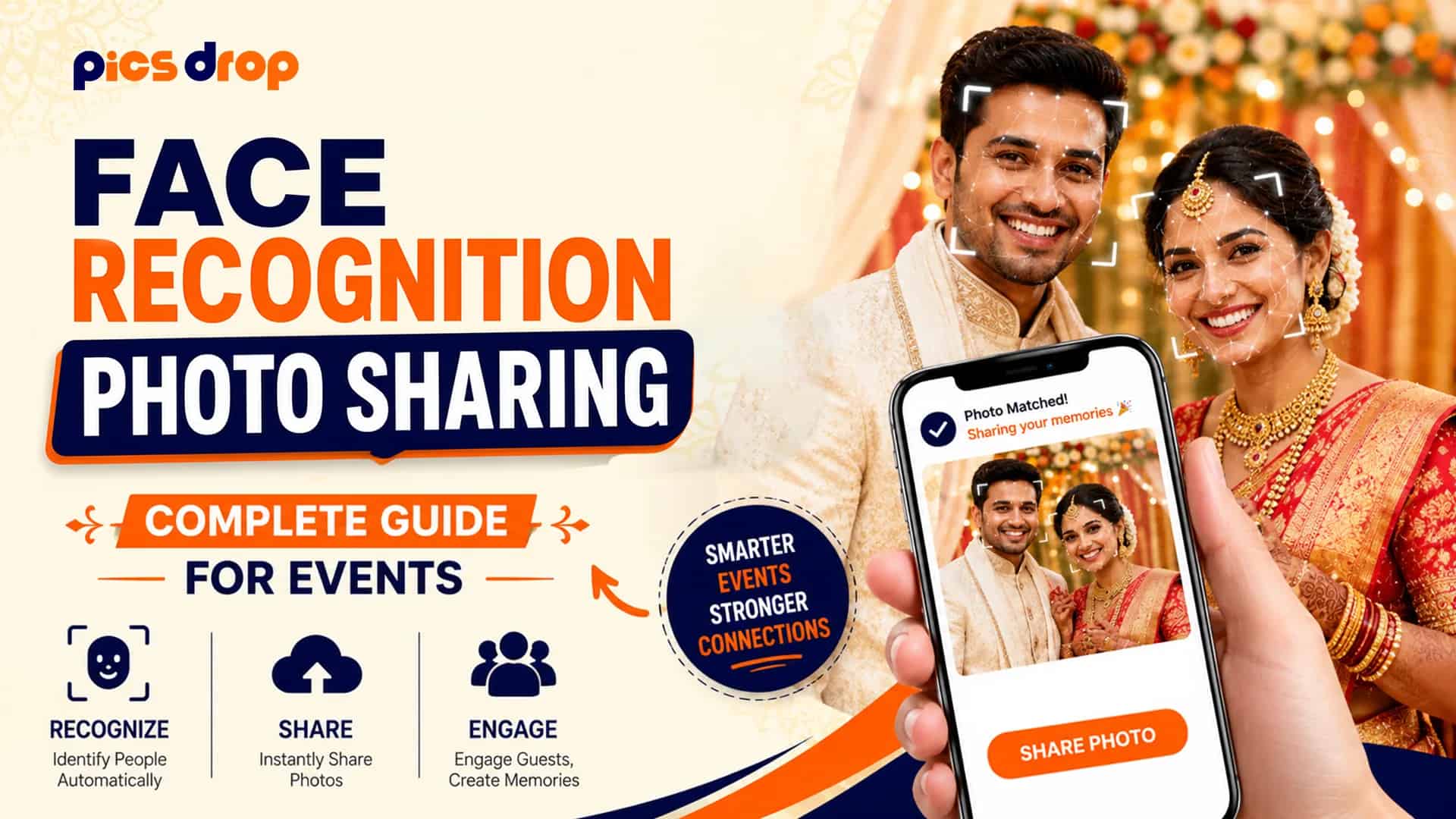
Picture this. A wedding with 600 guests, photographer has clicked 4000 photos, and now every single guest is messaging you asking "can you send me my photos?" That used to take days to sort manually. That is exactly the problem face recognition photo sharing fixes, and it does it in seconds.
This technology is not some future thing anymore. Photographers and event organizers both are using it regularly now, and guests literally love the experience of it.
How Face Recognition Photo Sharing Actually Works
The process is simple from guest side. When the event is done, a QR code is placed at the venue or shared on WhatsApp. Guest scans the code, opens the gallery on their phone itself, and uploads a quick selfie. The AI system then scans the whole photo gallery and matches that face. Every photo where that guest appears gets grouped into a private album automatically.
What happens is, the system converts each face into something called a face vector — basically a set of numbers that represents facial features like eye distance, nose shape, jaw structure. When the selfie comes in, it compares those numbers. If the match crosses a threshold, that photo goes into the guest album.
Group photos, side angles, dim lighting, partially visible faces — the good platforms handle all these without much trouble. Accuracy on leading platforms is around 99% these days.
No app download is needed. No account required. It works on any browser only.
What Used to Happen Before This Technology
Before face recognition photo sharing became common, event photography workflow was a mess honestly. Photographer would zip up thousands of photos, upload to Google Drive or WeTransfer, and share a link with everyone.
Now every guest gets the same massive gallery. Some scroll for 20 minutes, others give up halfway. Many photos go completely unseen because people just get tired. The photographer's hard work never fully reaches the audience.
And if someone specifically wanted "just my photos" — that meant photographer sitting for hours manually going through images. At a 500-person wedding, that is simply not possible.
The face recognition photo sharing approach flips this completely. Upload once, and every guest automatically gets their own personalized album.
Where This Technology Is Being Used
Weddings are the biggest use case, especially in India where guest count easily goes 300 to 1000. Sending individual photos to each person used to be nightmare. Now the QR code does that job itself.
Corporate events are using it too. Employees get their professional conference photos without bothering HR. Leadership gets their stage photos same day. No back and forth emails needed.
Marathon races and sports events also use this heavily. One race can produce 20,000 plus photos. Runners want their finishing moment, not someone else's. Face recognition photo sharing gives them exactly that in seconds.
School graduation ceremonies, birthday parties, concerts — basically any event with more than 100 photos starts becoming a candidate for this technology.
The Privacy Question
This is a fair concern and people does ask it. When AI is scanning faces, is that data being stored permanently somewhere? The short answer from reputable platforms is no.
The selfie is used only for matching. After the event period, the face data is deleted. Most platforms store face vectors, not the actual selfie image. And face vector by itself cannot reconstruct a face, it is just a set of numbers.
Before using any platform, three things to check. How long is face data stored. Whether the data is used for AI training or not. Whether guests actively opt in by uploading the selfie themselves.
Consent-based face recognition is fundamentally different from surveillance. Here the guest themselves choose to upload a selfie to find their photos. According to how facial recognition technology works globally, consent-based use is considered the responsible application.
What Photographers Actually Gain From This
Time saving is the obvious one. But there is more to it.
Photographers using face recognition photo sharing see higher photo download rates because guests actually find their photos instead of giving up mid-scroll. More downloads means more people sharing photos on social media, which means more visibility for the photographer.
Some platforms also allow watermarks to be added automatically. So every photo a guest shares online has the photographer's logo or website on it. Free marketing every single time.
Delivery speed also improves. A sneak peek gallery can go live during the reception itself. Guests are checking their photos while still at the venue, excitement level is highest at that moment.
FAQ
Q1. What is face recognition photo sharing?
It is an AI-based system where guests upload a selfie at an event, and the system automatically finds all photos of that person from the full gallery. No manual searching needed. The whole thing works through a QR code and takes less than a minute for the guest to set up.
Q2. Does it require guests to download any app?
No, most good platforms are browser-based. Guest just scans a QR code on phone, opens the page, uploads selfie, and the photos appear. No app installation, no account creation. Works on any smartphone.
Q3. How accurate is face recognition in real event conditions?
Top platforms report 99 percent or higher accuracy. The AI handles group photos, side angle shots, varying light conditions, and even partially visible faces. Occasional misses can happen in very dark or blurry photos, but the success rate is much better than manual searching.
Q4. Is face data safe and private?
When using responsible platforms, yes. The selfie is used only for matching and not stored permanently. Most platforms store face vectors, not actual images, and those vectors are anonymized. Guests also consent by choosing to upload their selfie themselves.
Q5. How much time does this save for photographer?
Sorting and individually sharing photos for a 500-guest event used to take 6 to 10 hours manually. With face recognition photo sharing, photographer just uploads all photos once and the system handles delivery to every guest. Total photographer effort comes down to under an hour.
Q6. Which types of events benefit most from this?
Weddings, corporate events, marathons, school graduation ceremonies, and concerts benefit the most. Any event with 100 plus guests and a large photo gallery is a strong candidate. The higher the photo volume, the more useful face recognition becomes.
This Is Where Event Photography Is Heading
Face recognition photo sharing is not a fancy add-on anymore. For any photographer shooting large events, it is quickly becoming the expected standard. Guests have experienced it at least once and now they expect it everywhere.
The photographers who adopt this early build a reputation for smooth, modern delivery. Those who still share Google Drive links with 3000 photos are going to lose clients to someone who does it smarter.
If you are a photographer or event organizer thinking about trying this, the setup is not much complicated. Platforms like PicsDrop make this setup possible in under 10 minutes.
If you want to try event face recognition photo sharing for your next event, setup takes under 10 minutes.