
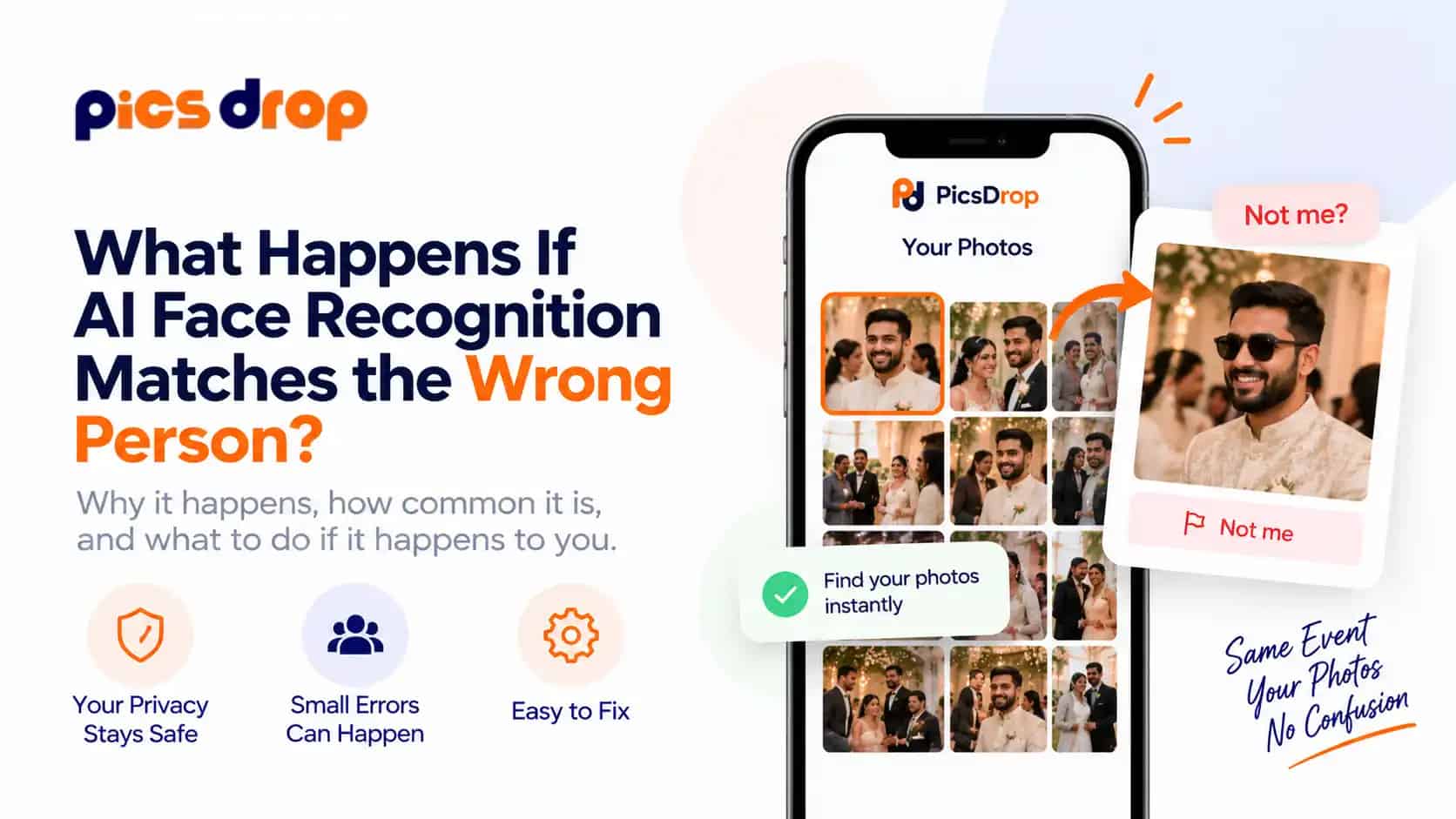
You scan the QR code, click a quick selfie, and the gallery shows up. But one of the photos clearly is not you, it's someone else from the same table. This happens sometimes with AI face recognition photo sharing, and it's a fair question to ask, what actually happens when the match goes wrong.
Short answer, nothing dangerous happens, but let's understand why it occurs and what a good platform does about it.
How the Matching Is Supposed to Work
Every photo sharing app that uses face search follows roughly the same process. The photographer uploads the full event gallery, the system detects every face in every photo, and converts each face into a numeric pattern. When guest uploads a selfie, that pattern gets compared against the whole set, and photos above a certain similarity score gets shown.
This whole thing runs on probability, not certainty. The system is not "looking" at a face the way a human does, it's doing AI photo matching based on distances between facial points. Most of the time this works great, but not always.
Why a Wrong Match Happens in the First Place
There are a handful of common reasons behind a wrong photo match, and honestly most of them come down to the photo itself, not the algorithm being lazy.
Poor lighting at the venue, motion blur from dancing or candid shots, someone wearing sunglasses or a heavy dupatta covering part of the face, or two guests who genuinely look alike, siblings, cousins, even just similar features from a distance. Group photos where faces are small and angled also increases the chance of an incorrect face match.
So How Accurate Is Face Recognition Actually
Most modern systems claim somewhere around 99% face recognition accuracy under good lighting and a clear frontal selfie. That number sounds high, but it's worth understanding what it means in practice.
Even at 99.9% accuracy, a gallery with ten thousand faces can still throw up a dozen wrong matches, this is just basic math, not a flaw specific to one app. According to independent reporting on facial recognition accuracy, even in near perfect conditions there is always a small margin of error baked into these systems. So a mismatch once in a while is expected, not a sign that the technology itself is broken.
What To Do If You Get a Wrong Match
If you spot a photo of a stranger in your results, most platforms give you a way to flag or remove it right there on the screen, no need to email anyone. Look for a small flag icon or a "not me" option under the photo.
On the flip side, if some of your own photos are missing, try uploading a clearer selfie, front facing, good light, no sunglasses or cap. A lot of missed matches fix themselves with just a better second selfie through selfie photo search.
Do Different Event Types Have Different Risk
Not really the platform, but the setting matters a lot. A wedding photo sharing app dealing with hundred of guests in dim reception lighting will naturally see more borderline matches than say a corporate headshot booth with controlled lighting.
Same goes for how the gallery is accessed. Weddings using a wedding QR code for photos printed on table cards tend to get photos from every possible angle and light condition throughout the night, which naturally is harder for any system compared to a well lit event photo sharing app setup at a corporate conference with fixed lighting.
Choosing a Platform That Handles This Well
A good sign to look for is whether the platform lets guests self correct mismatches instantly, instead of routing everything through the photographer. Also check if it supports rescanning with a fresh selfie, and whether it uses a proper QR code photo sharing flow so guests aren't stuck typing names or emails to fix an error.
Ready to Try a More Accurate Setup?
If mismatches at your last event were annoying, it might just be down to lighting or a poor selfie angle rather than the platform itself. AI face recognition photo sharing on PicsDrop lets guests flag a wrong photo or rescan in seconds, so small errors don't turn into a support headache for the photographer.
Try PicsDrop for Your Next Event →Frequently Asked Questions
Is it normal for face recognition to match the wrong person sometimes?
Yes, occasional mismatches are expected with any face matching system, especially in low light, group shots, or when two guests look similar. It's not a sign the platform is faulty.
Can I remove a wrong photo from my results myself?
Most platforms let you flag or remove an incorrect photo directly from your gallery screen, without contacting the photographer or support team.
Why are some of my own photos missing from my results?
This usually happens because of a blurry or angled selfie, poor lighting, or something covering part of your face like sunglasses. Uploading a clearer, front facing selfie usually fixes it.
Does a wrong match mean my data was leaked?
No, a mismatch is a technical error in comparing facial patterns, not a privacy or security breach. Your photo just got grouped with a similar looking face by mistake.
Are weddings more prone to mismatches than other events?
Slightly, yes. Dim reception lighting, candid movement, and large guest counts make weddings a bit trickier for face matching compared to well lit, controlled settings like a conference.
A wrong match now and then is just how probability based systems work, it's not something to panic about. What matters more is whether the platform makes it easy to fix, either by letting you flag the photo or rescan with a better selfie. Pick a setup that handles these small hiccups smoothly, and the occasional mismatch stays a minor annoyance rather than a real problem.